In this blog, Michael Geissmann examines how AI is driving a major transformation in data center power architectures. The article focuses on the growing adoption of DC-based systems and the importance of solid-state technologies in delivering efficient, reliable, and scalable power protection.
AI is redefining the design of modern data centers
The rapid growth of AI workloads is fundamentally changing the way data centers are engineered. Just a few years ago, most facilities were designed primarily around computing performance, while power infrastructure played a more supporting role.
Today, that situation has changed dramatically. With the expansion of AI, conventional data centers are evolving into what many refer to as “AI factories.” In these environments, power is no longer simply a utility service; it has become the foundation that enables the entire operation.
The AI transition: from steady growth to exponential demand
Traditional IT applications increased power demand gradually over time. AI workloads behave very differently. Recent industry studies show that GPU-driven systems are causing dramatic jumps in power density, with growth occurring not in small increments of 20%, but in leaps of 2x, 4x, or even 8x within a single hardware generation.
At the same time, workloads are becoming increasingly synchronized. Entire AI clusters can ramp up or down almost simultaneously and within extremely short timeframes, creating load fluctuations unlike anything seen in conventional data centers.
As AI-related power consumption rises, power infrastructure is shifting from a secondary consideration to the primary factor shaping facility design.
AI data center power architecture: the move toward 800 VDC
To accommodate these changing requirements, the industry is progressively investigating alternatives to traditional AC distribution systems, with growing interest in 800 VDC architectures.
Benefits of 800 VDC compared to conventional AC distribution
DC distribution offers several important advantages over AC systems, including:
- Fewer power conversion stages and lower energy losses
- Reduced copper usage and a smaller installation footprint
- Simpler integration of battery storage systems
Compared with standard AC architectures, 800 VDC systems can improve overall power delivery efficiency while also simplifying system layouts. Looking ahead, the industry is already considering 1500 VDC as the next step for achieving even greater efficiency and scalability.
Solid-state transformers and multi-bus DC architectures
Another significant evolution is taking place at the facility level. Instead of relying on multiple conversion stages, next-generation architectures are introducing:
- Solid-State Transformers (SSTs)
- Direct conversion from medium-voltage AC (for example, 35 kV) to 800 VDC
- Centralized DC distribution through a shared DC bus
- Multiple interconnected zones connected to the same DC infrastructure
These designs create systems that are cleaner and more efficient, but they also introduce additional complexity in protection and control. This is precisely where our customers benefit from the decades of experience we have built in DC-grid protection within the maritime sector.
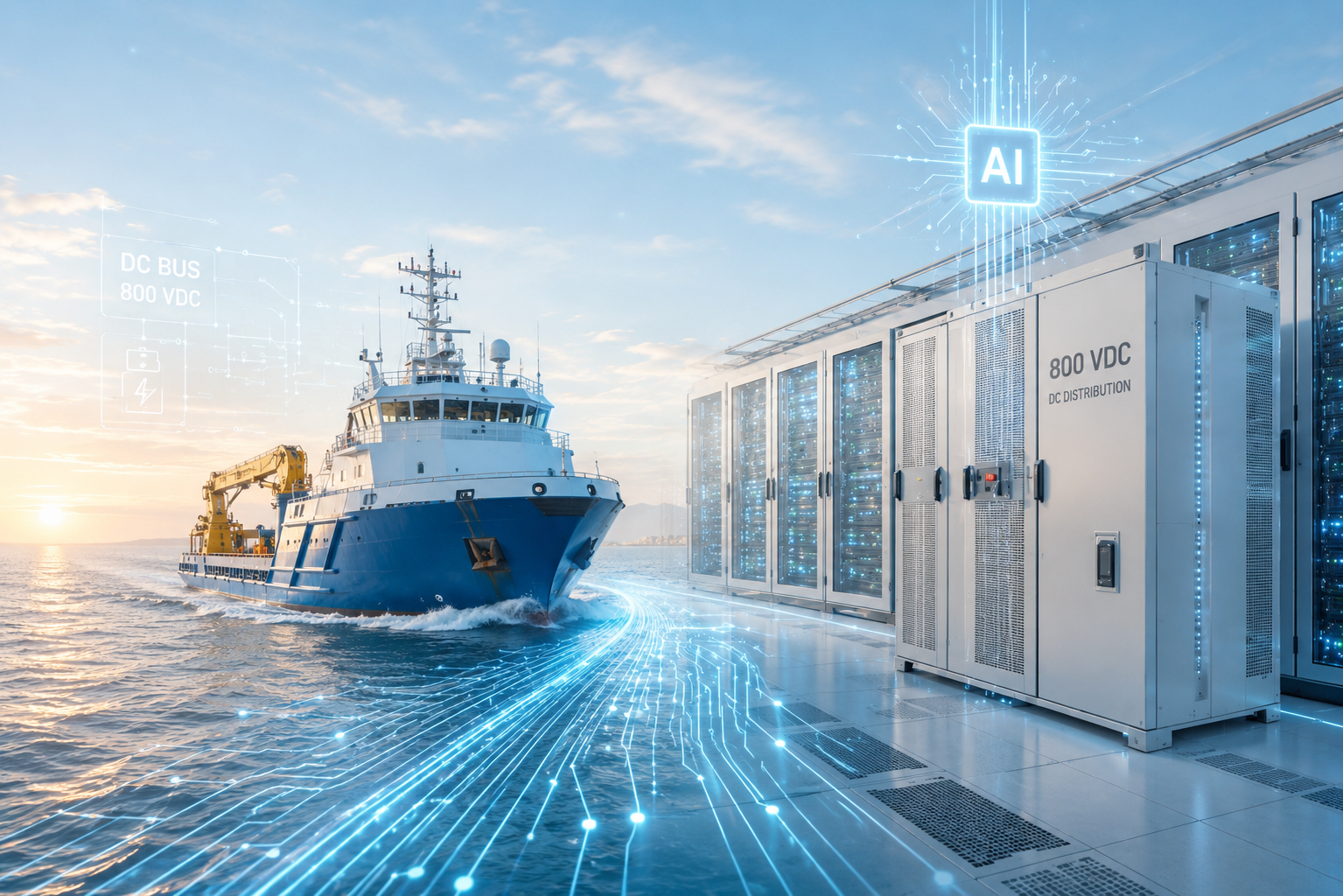
Déjà vu: AI data centers are beginning to resemble modern ships
At Astrol, we have spent many years developing advanced power electronics solutions, including our DNV, Lloyd’s Register, and CCS-certified portfolio of solid-state DC breakers for maritime DC grids. These technologies are built to meet the highest standards of safety, reliability, and performance in demanding marine applications.
What we already implement in maritime systems
Modern vessels already incorporate:
- DC bus architectures
- Multi-bus ring configurations
- Redundant power pathways
- Integrated energy storage systems such as batteries and supercapacitors
- Zone-based protection strategies
Similarities with AI data centers
When examining emerging AI data center designs, the parallels are immediately clear.
In both maritime systems and AI data centers:
- Power sources, battery storage, and loads are connected to a common DC bus
- Redundancy is essential
- Power flow patterns are highly dynamic
- Fault isolation must happen extremely quickly, often within microseconds
In many cases, modern data center topologies are even more complex than maritime systems due to the larger number of nodes and protection points involved. For us, however, these are not unfamiliar challenges; they are areas where we already have extensive experience.
The missing link: fast and dependable DC protection
As the industry moves toward 800 VDC and higher-voltage systems, one key question becomes increasingly important: how do you effectively protect high-power DC systems with extremely dynamic behavior?
Traditional mechanical breakers and fuse-based solutions are often too slow and insufficiently flexible for these requirements.
What the industry requires
Modern AI infrastructure demands:
- Ultra-fast fault detection and interruption within microseconds
- Accurate and selective fault isolation
- Scalable protection for increasingly complex architectures
This is exactly where our solid-state DC breaker technology provides value. We offer a range of ultra-fast, IGBT-based, liquid-cooled 800 VDC breakers specifically designed to address the demands of data center environments.
From maritime know-how to AI infrastructure
Astrol brings more than a decade of expertise in developing solid-state DC breakers, originally designed for challenging maritime applications and now supporting the next generation of AI-powered data centers.
Our background includes experience with:
- High-, medium-, and low-voltage DC systems
- Mission-critical and harsh operating environments
- Advanced and complex grid topologies
- Protection for integrated energy storage systems
For this reason, entering the data center market is not about inventing entirely new technologies; it is about applying proven solutions to a rapidly evolving industry. Because our technology originates from the 1500 VDC maritime sector, it is naturally well suited for handling the demands of 800 V systems while preserving appropriate safety margins.
Key similarities include
- 800 VDC systems → already within our existing expertise
- Future 1500 VDC architectures → supported by more than ten years of operational experience across hundreds of systems
- Battery and supercapacitor protection → a core element of our portfolio
- Ring and multi-bus topologies → standard practice in modern hybrid and electric vessels
In other words, many of the challenges now emerging in data centers are technologies we have already been working with for years.
Looking forward
The transition toward AI-driven infrastructure is not only about increasing computational capacity; it is about fundamentally redefining power delivery.
The industry is moving toward:
- Higher DC voltages (from 800 VDC toward 1500 VDC)
- Fully DC-based power distribution architectures
- Integrated energy storage across multiple system levels
- Highly dynamic load profiles increasingly influenced by software
Within this new landscape, power electronics are becoming a strategic part of infrastructure design. At Astrol and Astrolkwx, we see this evolution as a natural continuation of our journey.
Conclusion
From ships to servers, the underlying principles remain unchanged:
- Efficiency
- Reliability
- Control
- Protection
And as system complexity grows, experience becomes increasingly important. AI may be new, but the challenges associated with managing sophisticated DC topologies are not. The discussion is no longer about whether data centers will adopt these architectures, but rather about who is prepared to support them at scale.
Contact us for more information, a deeper technical discussion, or an exchange of ideas regarding your upcoming projects.